
 0
0



BLOG
Health Insights & Articles
- Home
- Blog
- Tinnitus column
- Feeling Dizzy or Vertigo? Five Common Causes Explained
Feeling Dizzy or Vertigo? Five Common Causes Explained

Dizziness and vertigo are among the most common symptoms people experience. In many cases, they may be caused by a lack of sleep, low blood pressure, low blood sugar, or other temporary conditions that often improve with adequate rest or dietary adjustments. As a result, many people consider dizziness to be nothing more than a minor inconvenience. But is that really the case? In this article, Dr. Chien-Chih Chen, a dual specialist in otolaryngology and neurology, and Dr. Ping-Tao Tseng, a psychiatrist, explain the common causes of dizziness and vertigo and discuss when medical evaluation is necessary.
People experiencing dizziness often describe symptoms such as head pressure, lightheadedness, feeling faint, or blurred vision. These symptoms commonly occur with sleep deprivation, low blood pressure, low blood sugar, anemia, and similar conditions.
Vertigo, on the other hand, is characterized by a spinning sensation. Dr. Tseng explains that patients often feel as though either they or their surroundings are rotating. Vertigo is also frequently accompanied by balance problems, a heavy-headed sensation, a floating feeling in the legs, or the perception that the environment is moving.

▲ Identifying the true cause of dizziness requires careful evaluation by an experienced physician. (Image source: Freepik)
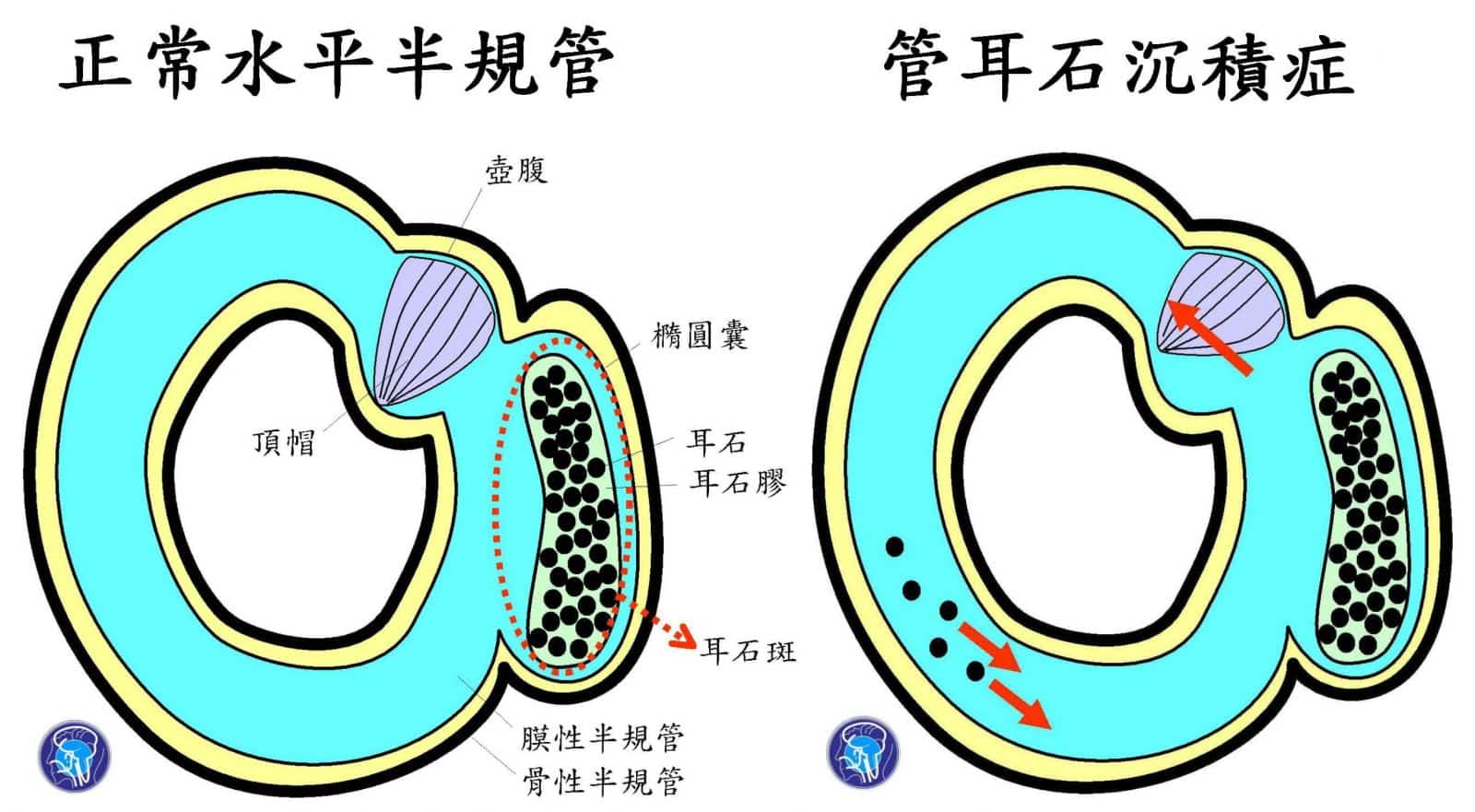
▲ Once otoconia become dislodged from the utricle, they may settle within the horizontal semicircular canal or adhere to the cupula, resulting in vertigo.
The sinus mucosa contains trigeminal nerve fibers capable of releasing calcitonin gene-related peptide (CGRP), particularly within the maxillary sinuses. Inflammation or increased pressure within the sinuses stimulates the release of CGRP, which may trigger migraine attacks. During a migraine, abnormal electrical activity begins in the brainstem and passes through the vestibular nuclei, disrupting balance function and causing vertigo before eventually producing headache symptoms.
As these examples demonstrate, the causes of dizziness and vertigo are diverse and often complex. Simply sleeping more or taking anti-vertigo medication may temporarily relieve symptoms, but these measures usually address only the symptoms rather than the underlying cause. Patients are therefore advised to avoid self-diagnosing or relying on unverified home remedies found online. While anti-vertigo medication may provide temporary symptom relief, seeking evaluation from a qualified physician remains the best way to identify the true cause of dizziness and receive appropriate treatment, ultimately improving quality of life.
Dizziness vs. Vertigo: What's the Difference?
Although the terms dizziness and vertigo are often used interchangeably, they do not describe exactly the same condition. Dr. Chen points out that even in vertigo clinics, most patients describe their symptoms simply as "dizziness" rather than the more precise term "vertigo." The key distinction lies in whether a spinning sensation is present.People experiencing dizziness often describe symptoms such as head pressure, lightheadedness, feeling faint, or blurred vision. These symptoms commonly occur with sleep deprivation, low blood pressure, low blood sugar, anemia, and similar conditions.
Vertigo, on the other hand, is characterized by a spinning sensation. Dr. Tseng explains that patients often feel as though either they or their surroundings are rotating. Vertigo is also frequently accompanied by balance problems, a heavy-headed sensation, a floating feeling in the legs, or the perception that the environment is moving.
▲ Identifying the true cause of dizziness requires careful evaluation by an experienced physician. (Image source: Freepik)
Five Common Causes of Dizziness and Vertigo
Because dizziness and vertigo are frequently confused in everyday conversation, making an accurate diagnosis can be challenging. Physicians must distinguish among hundreds of possible causes based on a patient's subjective symptoms, clinical experience, physical examination, and appropriate diagnostic testing. Below, Dr. Chen and Dr. Tseng introduce five common causes of vertigo and explain why proper medical evaluation is so important.Cause 1: Benign Paroxysmal Positional Vertigo (BPPV)
One of the most common causes of vertigo is benign paroxysmal positional vertigo (BPPV). Inside the utricle of the inner ear are millions of tiny calcium carbonate crystals known as otoconia, which are normally held together within the otolithic membrane. When these crystals become dislodged, they may drift with the endolymph and settle within a horizontal semicircular canal or adhere to the cupula. Changes in head position or stopping head movement allow gravity and inertia to move the displaced crystals, disturbing the flow of endolymph and triggering involuntary eye movements (nystagmus) and vertigo.▲ Once otoconia become dislodged from the utricle, they may settle within the horizontal semicircular canal or adhere to the cupula, resulting in vertigo.
Cause 2: Semicircular Canal Injury
Previous head trauma may fracture the bony horizontal semicircular canal, leaving a small defect while the membranous canal remains intact. During head movement, the flow of endolymph becomes disturbed at the injured site, causing the brain to incorrectly perceive that the head is still moving, resulting in vertigo.Cause 3: Oscillopsia
Oscillopsia commonly occurs during migraine attacks, sleep deprivation, or alcohol intoxication. These conditions affect the brainstem's vestibulo-ocular reflex, slowing eye movements and reducing the eyes' ability to smoothly track moving objects. As a result, images projected onto the retina become unstable. When these visual disturbances exceed the retina's detection threshold, they create a false sensation of imbalance and trigger vertigo.Cause 4: Neck Muscle Pain
Have you ever felt increasingly dizzy after looking at your phone for a long time? The cause may not simply be eye strain. Poor posture—such as constantly looking downward at a smartphone or turning the head to one side while watching television—can overwork the sternocleidomastoid muscle. Over time, lactic acid accumulates, causing muscle pain and stiffness. In more severe cases, even turning the head may trigger muscle spasms. Because the muscles on each side of the neck send different proprioceptive signals to the brain, this imbalance may create the sensation of vertigo.Cause 5: Vestibular Migraine Associated with Sinusitis
Vertigo may also originate from the nose. The paranasal sinuses help reduce the weight of the skull and contribute to vocal resonance. However, viral infections, allergies, trauma, foreign bodies, or tumors may block the sinus openings, causing mucus to accumulate and bacteria to proliferate. When inflammation persists for more than three months, chronic sinusitis may develop.The sinus mucosa contains trigeminal nerve fibers capable of releasing calcitonin gene-related peptide (CGRP), particularly within the maxillary sinuses. Inflammation or increased pressure within the sinuses stimulates the release of CGRP, which may trigger migraine attacks. During a migraine, abnormal electrical activity begins in the brainstem and passes through the vestibular nuclei, disrupting balance function and causing vertigo before eventually producing headache symptoms.
As these examples demonstrate, the causes of dizziness and vertigo are diverse and often complex. Simply sleeping more or taking anti-vertigo medication may temporarily relieve symptoms, but these measures usually address only the symptoms rather than the underlying cause. Patients are therefore advised to avoid self-diagnosing or relying on unverified home remedies found online. While anti-vertigo medication may provide temporary symptom relief, seeking evaluation from a qualified physician remains the best way to identify the true cause of dizziness and receive appropriate treatment, ultimately improving quality of life.


Prospect Clinic for Prospective Medicine
The original intention of Prospect Clinic for Prospective Medicine was to establish an integrated diagnosis and treatment space that combines otolaryngology and neurology specialties, so that complex tinnitus, dizziness, headaches and auditory nerve-related problems can be more completely evaluated and cared for.


Article Classification
Recent Articles
- Why Isn't Ginkgo Helping Your Tinnitus?
- Analysis of Six Types of Tinnitus: From Normal Response to Disease Warning Signs, Understand Them All at Once
- Why can’t tinnitus be treated with medication alone?
- The more advanced the equipment, the better the medical treatment? Solving common myths about Taiwanese patients
- Tinnitus is not a hallucination! EEG reveals the brain's distress signals.